

What happens after revival? Scripture and church history consistently point to the same answer: revival is meant to become a movement. A revival that stays a single moment eventually fades, but a revival movement—one that multiplies through ordinary believers who keep sharing Jesus with the people around them—can saturate a neighborhood, a city, even a nation. At Forge we call those ordinary believers Kingdom Laborers. What comes after revival matters even more than the moment itself. To see why, let me start with a slow drip in my basement.
A Slow Drip Can Bring Down a Ceiling
Just about two years ago my wife, Taylor, and I moved. At the time, our son was 18 months old and Taylor was eight months pregnant with our daughter. Anyone who has moved knows how crazy it can be. Our experience was no exception. Packing, loading, unpacking—it really can be an exhausting event.
On top of it all, the previous owners had taken the refrigerator, washer, and dryer, so we needed to move those in as well. So much to do.
By day three of the move, I was dead tired. I had just sat down for a few minutes of rest before bed when my phone rang. On the other end was my sister-in-law, who was going to be living in the basement. In a worried tone she said, “Nathan, you might want to come look at this.” Immediately my heart sank. I raced to the basement to discover a steady stream of water leaking through the ceiling and onto the floor of the basement bathroom.
I was a mixture of panicked and angry as I processed the news through my exhausted body and mind. “Well,” I thought, “We had better figure this out. Can’t just wait for the drywall on the ceiling to collapse.”
So, I raced around looking for the source. After about an hour of searching, I discovered the culprit. Our newly installed washer had a slow leak. Whoever had hooked up the washer (it was me!) had not tightened the connection to the water line properly. This resulted in a slow drip. One drop every three to five seconds. Truly, anyone looking at it would call it a slow drip.
In my exhausted mind it almost wouldn’t connect. How could such a slow drip cause such a major production of water in the ceiling below?
After three days of slow dripping, what had started as a small leak had become a potentially ceiling-collapsing event. And sure enough, as soon as I stopped the drip and dried up the puddle on the floor, the basement ceiling stopped leaking as well.
Sometimes we underestimate the effect that a collection of small decisions, actions, or events can have. But a slow drip of water is a good reminder that over time, these small actions can lead to major changes.
This is a crucial thing to remember as we consider revival and the work of God’s Kingdom.
Are We in a Revival Season Right Now?
When we think about God’s Kingdom advancing in our world, we often look for big events. Some call them revival-level events: moments where large numbers of Christians are getting serious about their faith, and large numbers of non-Christians are coming to faith.
Many of the spiritual leaders I work and do ministry with are saying we are in a revival season right now. I tend to agree. I was utterly convinced of this about two years ago when some Christian brothers working among Muslims in the Middle East shared with me that their work had suddenly become noticeably easier. They were seeing increasing openness and decisions for Jesus unlike anything they had witnessed in the previous 30 years.
Add to that the reports from around the world of people coming to Christ in large numbers, thousands being baptized, and entire nations shifting. It is clear that God is up to something in our day.
That said, there are those who argue the opposite, that these are not revival fires from the Lord. Whether we choose to call it revival or something else, the reports are difficult to ignore. God is clearly at work.
For me, the real question is not whether God is moving, but rather: what is He up to, and how can I be a part?
As a wise friend of mine likes to say, “Wherever I go, I am going to assume that God is already at work in that place among those people.” I agree wholeheartedly. Whatever you call what is happening right now, Jesus is clearly at work. The question is how we steward God’s revival movement, and more than that, how we multiply it.
Pentecost Was a Beginning, Not an Ending
The book of Acts has much to say about how to steward revival.
On the day of Pentecost, we find a core group of 120 followers of Jesus praying in an upper room. When the Holy Spirit comes, they immediately begin proclaiming the Gospel to the crowds gathered in Jerusalem for the feast. Acts 2 records that more than 3,000 are added to their number that day. By Acts 4 that number has grown to 5,000 men. Through Acts 5 and 6 the movement keeps spreading. By Acts 8, persecution scatters everyone except the apostles into Judea and Samaria. . . AND the movement goes with them!
In eight short chapters we go from 120 gathered in an upper room to thousands spreading across Judea and Samaria and, as you keep reading, far beyond to distant lands.
This is the crucial thing to notice: Pentecost was not an ending; it was a beginning. The Holy Spirit did not fall on the disciples so that they could have a powerful experience and go home. The Spirit fell so that they could multiply and make more disciples. The awakening was always for the sake of what came next.
Revival Has Always Produced Revival Movements
There is a fascinating secular book by historian Rodney Stark called The Rise of Christianity, where Stark argues (based on demographic modeling) that the vast majority of early church growth must be attributed to ordinary relational connections. Christianity may have had a fast start at Pentecost, but the sustained growth happened as people heard the Gospel from friends and neighbors in one-to-one settings. Though I don’t fully agree with everything Stark concludes, it is striking that his argument closely mirrors the Acts 8 model: ordinary people, scattered by circumstance, sharing the Gospel wherever they go.
Revival, in other words, produced a revival movement. That revival movement was carried by ordinary believers, not just apostles.
This is not unique to the early church. Church history bears out the same pattern again and again: revivals that produced lasting fruit were revivals that produced movements.
The Second Great Awakening in early 19th-century America didn’t just fill churches; it sparked what historians call the Benevolent Empire, a wave of voluntary societies that led to the abolition of slavery, prison reform, and an explosion of missions organizations. The awakening translated into action, and the action multiplied.
The Welsh Revival of 1904–1905 saw over 100,000 people come to faith in a matter of months. But its most enduring legacy was its global impact on missions. The revival’s fire spread to other countries and helped fuel a generation of missionary activity around the world.
Why Some Revivals Fade and Others Become a Movement
But not every revival has produced that kind of lasting fruit. History is also full of moments where genuine spiritual energy burned bright for a season and then faded. I don’t think it’s because God wasn’t in it, but because the awakening never found its footing in the ordinary rhythms of discipleship and multiplication.
Here is my point: revival’s goal is, and should always be, multiplying movements of ordinary people who go on to impact the people near to them. Here at Forge, we call these people Kingdom Laborers. You may be tempted to think that big, revival-level movements that emerge from revival-level events require big names and big organizations. Acts proves that this is not the only way.
When you collect enough small acts of obedience together, you get a big one.
Think back to the slow drip. A single drop every few seconds seems like nothing. But sustained over days, it saturates the ceiling and brings it down.
That is a crucial picture of a genuine revival movement. It’s not just a dramatic moment, but a sustained, multiplying flow of ordinary disciples being trained by Jesus and training others to follow Him as well.
This is what Pentecost modeled. This is what the Welsh Revival and the Second Great Awakening achieved at their best. And this is what God appears to be inviting us into again right now.
What a Multiplying Movement Looks Like
So, what does this look like practically? At Forge, we talk about a simple framework for the Kingdom Laboring life built around four rhythms. Ordinary believers who:
- See,
- Stop,
- Spend Time,
- and Share.
These laborers notice the people God has placed in their path, pause to be present with them, invest in relationship, and share the lifesaving message of Jesus.
Applied at scale, this is what a multiplying, revival movement looks like: not a handful of professionals doing ministry on behalf of everyone else, but every believer living as a disciple, as a laborer.
When we all engage with the people around us, we keep revival from becoming an event we remember when it is meant to be a life we live.
Truly, when revival fires begin to burn, the question shouldn’t be “how do we keep this going?” but rather, “how do we help this fire multiply?”
From Witnesses to Multiplying Laborers
Back to the slow drip.
What strikes me about that moment in my basement is that the problem was not dramatic. One small loose connection. A few drops every few seconds. But sustained over three days, it nearly brought down a ceiling.
That is both a warning and an invitation.
The warning: don’t assume that because something looks small, it isn’t significant. Movements of God may not always look impressive. A hundred and twenty people in an upper room. A handful of Welsh farmers at a prayer meeting. A few believers whispering the Gospel to their neighbors in the ancient world. It looks small… but the impact is not.
The invitation: your faithfulness matters more than you know. Your small decisions to see someone, stop for them, spend time with them, and share the hope you carry, may feel insignificant to you. But when we all do this together and we do it over time, this can saturate a city, a neighborhood, a nation with the presence of God.
If we are indeed in a revival season—and I believe we are—then the question before each of us is not whether God is moving. He is. The question is whether we will be positioned to move with Him, not just as witnesses to something happening around us, but as multiplying Laborers who carry the revival movement into every corner of the world He has placed us in.
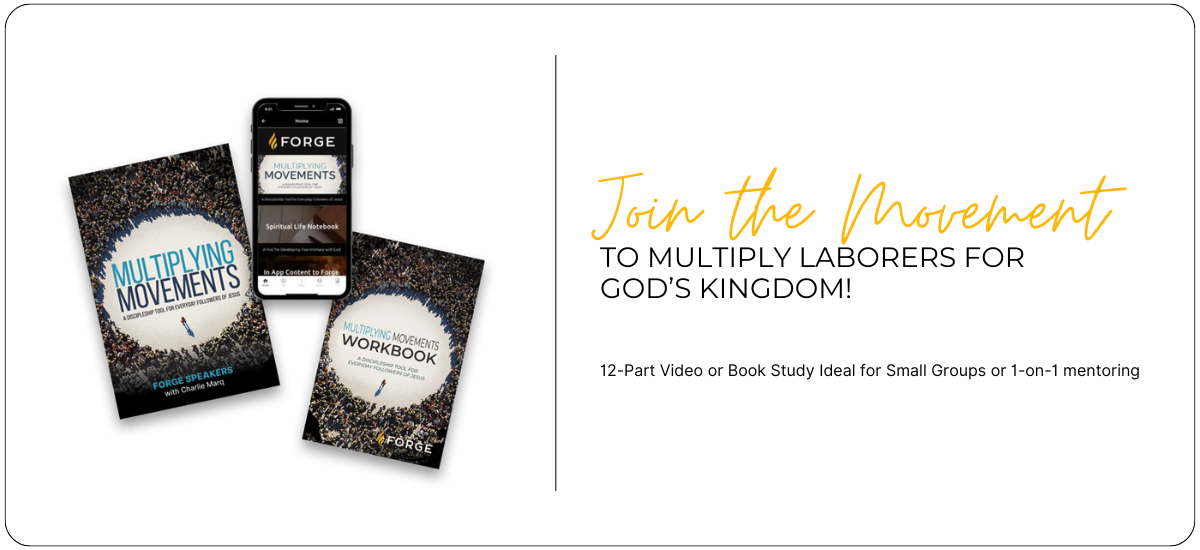
A revival movement is born when ordinary believers learn to multiply. Multiplying Movements is a powerful discipleship resource for becoming—and making—Kingdom Laborers. → Explore Multiplying Movements
