
Writing your testimony comes down to three simple parts: what your life was like before Jesus, how you met Him, and how your life is different now. That’s the whole framework. You don’t need a dramatic conversion story or a seminary degree to do this well—you need your own story, written down, so you’re ready to share it when the moment comes.
At Forge, we call your testimony your God-Story: a time when God showed up for you. Here’s why writing it matters: when you put your God-Story on paper, it stops being a vague memory and becomes something clear, specific, and ready to share. Writing strengthens it. You stop fumbling for words and start telling it with confidence.
This guide walks you through how to write your testimony step by step, how to share it naturally, and how to adapt it for different people. We’ve also built a free worksheet to help you do the writing!
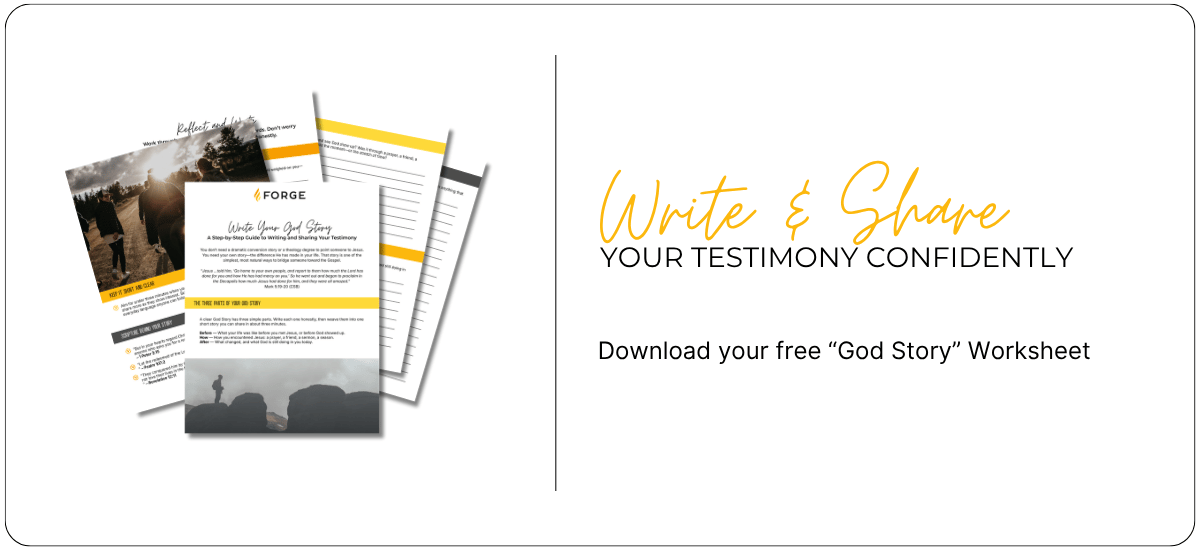
Download the free God-Story Worksheet—a step-by-step printable to help you write and share your testimony confidently. Get the worksheet →
Your Testimony Is Your God-Story
A God-Story doesn’t have to be the story of how you first met Jesus, though it can be. It can be any time God simply showed up: a prayer He answered, peace He brought in the middle of anxiety, a relationship He reconciled, a need He met when you had no idea how the bills would get paid. Has God ever shown up for you? More than once? Those are your God-Stories.
People connect with stories. A good story is approachable, real, and authentic, and it meets people at a heart level in a way that an argument never will. That’s what makes your testimony one of the simplest and most effective methods of sharing the Gospel. In Mark 5, a man Jesus had radically changed did nothing more than tell people what Jesus had done for him—and his entire region was transformed.
“Jesus…told him, ‘Go home to your own people, and report to them how much the Lord has done for you and how He has had mercy on you.'” (Mark 5:19, CSB)
God’s Plan A to reach the world runs through ordinary people, and there is no Plan B. You are God’s Plan A—His extreme measure to reach the people in your everyday life. That’s both exciting and a little nerve-wracking, and that’s okay. Your job isn’t to be impressive. Your part is simply to tell the truth about what God has done.
The Before/How/After Framework
To give your testimony structure, it helps to organize it into three parts. Walk through them in order, and you’ll have your God-Story.
- Before: Your Life Before Jesus
Start with what your life was like before God showed up—or before this particular season of faith. What were you searching for? What pain or emptiness did you carry? Maybe you were anxious or depressed. Maybe you were proud and trying to run everything yourself. Maybe you hit a stretch where you wondered how you’d make ends meet. Name the real struggle honestly. This is the part people relate to most.
- How: How You Met Jesus
Next, tell how God broke through. Be concrete, not abstract. Where were you? What happened? Maybe you were sitting in your car listening to a song. Maybe it was a sermon, a Sunday school class, or a coffee meeting where a friend spoke loving truth into your life. Maybe you were alone in a room, praying. Whatever it was, describe the actual moment, person, or season God used. Specifics make a story more tangible.
- After: How Your Life Is Different Now
Finally, share what changed. Maybe you went from fearful to courageous, from despair to hope, from anxiety to peace. Maybe God provided when you had no idea how the need would be met. Don’t just say things got better—say what got better, and what God is still doing in you today. End on Him.
Practical Tips for Writing Your Testimony
- Keep it to three minutes or under. People are busy, and a short story respects that. You can always share more if someone asks. Aim to tell your God-Story in one or two minutes.
- Make it specific. A desperate moment, a particular song, a sentence a friend said—concrete details are what make a story stick.
- Avoid Christianese. Words like redeemed, saved, or washed in the blood may mean nothing to someone outside the church. Use everyday language anyone can follow.
- Lead with vulnerability. Honesty about your “before” earns trust faster than anything polished. Don’t be afraid to name the hard part.
- Aim for one Gospel-connection point at the end. Your story is the bridge; the Gospel is what it bridges to. Plan a simple sentence that connects what God did for you to what He offers everyone (more on this below).
A Short Sample Testimony
Here is one of Forge Speaker Adrian Despres‘ own God-Stories, told in about a minute:
Growing up, I was a kid full of fear, anxiety, and worry—and on top of it all, full of pride. I was a mess, trying to live my own life my own way. I figured if I just did all the right things, I’d end up satisfied. I didn’t. I ended up as lonely as I had ever been—so alone that I started considering ending it all.
One day, in the middle of that loneliness, I thought, Maybe I should finally do what all those preachers kept telling me to do. So I went into the closet of my childhood bedroom, sat down on the floor, shut the door, and prayed: Jesus, will You please show up? Will You intervene?
And He did. He really did. My loneliness turned to satisfaction. My depression was replaced with joy. I had been so fearful I could barely say hello to the person next to me at lunch—and Jesus turned me into someone who can’t stop telling people about Him. That’s the difference Jesus made in my life.
Notice the shape: a few honest sentences about before, one concrete moment for how, and a clear, specific after that ends on what Jesus did.
Bridging to the Gospel
Right after you share your God-Story, connect it to the Good News that is available to the person you are sharing with. It can be this simple:
“This was possible in my life because Jesus died on the cross for our sins, which separated us from God. And He rose from the dead, which means He’s alive today and wants a relationship with us. He loves us that much.”
You can find this Gospel message most simply stated in 1 Corinthians 15: “…that Christ died for our sins according to the Scriptures, that he was buried, that he was raised on the third day according to the Scriptures.” Then ask a question—something like, “Would you like this in your life too?” A question moves the conversation from you to them and invites them to consider their own story. If someone is ready to give their life to Christ, you can pray with them right there; Romans 10:9 is a helpful guide for that moment: “If you confess with your mouth, ‘Jesus is Lord,’ and believe in your heart that God raised him from the dead, you will be saved.”
This is the natural “Share” in Forge’s See, Stop, Spend Time With, Share rhythm. First you see, stop, and spend time with people—showing genuine love, listening more than you talk, treating them as humans and not as targets. Then, when you find a place in their story that resonates with yours, you share your God-Story.
Adapting Your Testimony for Different Audiences
The same God-Story flexes to fit the person in front of you.
- A skeptical friend. Drop every church word and lead with your real struggle. Don’t preach—just tell what happened to you, stay conversational, and leave room for their questions.
- A fellow Christian. Here you can use shared language freely. Focus on encouragement and what God is still doing. This is the version for a baptism testimony or a small group share.
- A child. Keep it simple and concrete: one feeling before, one moment, one change. Short sentences.
- A longer setting versus an elevator pitch. For a small group, you can add detail or even a second mini God-Story. For an elevator-length version, cut to one before, one how, one after, and your question. Either way, aim for under three minutes.
If you’re a newer believer sharing for the very first time, our guide on how to share your faith as a new Christian walks through the same framework at a gentler pace. And if the people on your heart are relatives, see how to share the Gospel with family.
What NOT to Do
A few common mistakes to avoid:
- Don’t make yourself the hero. The point of your testimony is what God did, not how impressive, smart, or strong you were. Keep Him at the center.
- Go easy on the Christianese. Insider vocabulary creates distance. Translate it into plain words.
- Don’t glorify the sin. You can be honest about your past without dwelling on it or making it sound appealing. A quick, truthful sketch is enough.
- Don’t trail off. End somewhere specific—what changed, and a simple question—rather than a vague “and now everything is better.”
Bible Verses to Anchor Your Testimony
Let these verses encourage you as you write and share:
- Mark 5:19-20: Jesus tells a changed man to go and report “how much the Lord has done for you.”
- Psalm 107:2: “Let the redeemed of the Lord proclaim that He has redeemed them from the power of the foe.”
- 1 Peter 3:15: “Be ready at any time to give a defense to anyone who asks you for a reason for the hope that is in you.”
- Revelation 12:11: believers overcome “by the word of their testimony.”
- Acts 4:20: “we are unable to stop speaking about what we have seen and heard.”
Write Yours Today
You don’t have to wait until you feel ready. Has God shown up for you? Then you already have a God-Story worth telling. When ordinary believers start sharing what Jesus has done for them, movements multiply—one conversation, one life at a time. That’s the heart of the Forge Multiplying Movements resource, and it starts with a single story: yours.
So write it down. Practice it. Then go tell it.
Ready to put yours on paper? Download the free God-Story Worksheet, a step-by-step printable to help you write and share your testimony confidently. Get the worksheet →