
In Matthew 9:37, Jesus says, “The harvest is plentiful, but the Laborers are few.“ But what does this mean? And how is it relevant to us today?
The Meaning of “The Harvest Is Plentiful”
Take a drive through the American Midwest and Great Plains in early August, and you will find yourself surrounded on every side by crops ready for the harvest: corn, soybeans, and vegetables of all kinds. It is impossible to ignore the sheer massive scale of the crops ready for the harvest. They stretch as far as your eye can see—hundreds of thousands of acres—and it seems like there is no end.
If you are anything like me, the thought of the harvest that will soon commence is overwhelming. There is so much work to be done!
Jesus faced a similar need…
In Matthew 9, we find Jesus traveling through all the towns and villages, proclaiming the good news, teaching, and healing. In verse 36, we see Jesus feeling compassion toward the crowds of people. He was burdened by the massive spiritual and physical needs of the people around Him. What Jesus saw in the eyes and faces of people burdened Him—compassion filled His heart and gripped His gut. The human plight He witnessed in every direction reminded Him of a very familiar scene: lost and wandering sheep, harassed and helpless, with no shepherd to care for them or lead them to safer, greener pastures. At this moment, as He is filled with compassion, He turns to the disciples and says, “The harvest is plentiful, but the Laborers are few.”
It’s a big problem! There are so many people with so many needs. During His earthly ministry, His divine ability to be in any place at any time was restricted. The vast number of people and all of their needs were immense. It led Jesus to feel the same feeling I have as I drive down a Nebraska highway in August: There is so much work to be done. The harvest is plentiful!
Picture an apple orchard that spreads as far as your eye can see. Trees loaded with ripe red apples bend low and kiss the ground—so many nutritious and delicious apples, right there and ready. And it’s not just a “good” crop. This is a bumper crop—or as Jesus said it, “a plentiful harvest.” The picture Jesus painted for the disciples was a ripe and ready harvest, not of apples, but of people wanting more, needing more, and ready for more. Harvest-ready people, here and there and everywhere, were one step away from the God-centered, joyous life always meant for them.
Why This Is Still Relevant Today
Spiritually speaking, nothing has changed from the days of Jesus. The harvest Jesus spoke about is still just as plentiful as it was 2,000 years ago. There are people in desperate need of Jesus everywhere we step foot. The needs only increase as you take note of all the places where you commonly go. Roughly 78% of Jesus’ ministry was spent in ordinary, everyday places. Think of all the ordinary places you regularly go where there are people who need Jesus.
When we start thinking in terms of the way Jesus did ministry, our eyes are opened up to the massiveness of the spiritual harvest all around us. Jesus did not restrict His care for people based on their characteristics or beliefs. No, He crossed all kinds of barriers.
- Social
- Political
- Economic
- Geographic
For Jesus, the harvest had no restrictions, which means it was huge. And the same holds true today.
The numbers are staggering. Only 2.2 billion of the 7.88 billion people on Earth today claim to be Christian. That leaves 5.68 billion people today who don’t know or follow Jesus. About 3.28 billion of those 5.68 billion have limited or no access to Jesus. The needs are immense! The harvest is indeed plentiful.
Billions still have no access to Jesus at all. Reaching them takes both goers and senders—and every Christian is one or the other.
We rarely think in terms of billions, so let me illustrate just how large of a number that really is. Take, for instance, time—like the fact that 5.68 billion seconds is over 180 years. The largest stadium in the world (1st of May Stadium in North Korea) can seat 150,000 people at a time. You could fill it 37,866 times (and have a little left over). If I were to try to preach to 10,000 per week, it would take me just short of 11,000 years to preach to all 5.68 billion non-Christian people on Earth. The harvest is indeed plentiful.
Eleven thousand years is immense—that’s 145 lifetimes. Unfortunately, we only have one life to live. It’s easy to start thinking the work is just too much.
This feeling of helplessness can only be compounded when you consider the needs of the people who have limited or no access to Jesus. There are people in nations all around the world who cannot hear about Jesus because of a law or social rule in their country. Millions of people are locked away from access to Jesus. These are not people who have heard the good news and rejected it; these are people who have never had the opportunity to hear it in the first place, as the gospel has not been preached to all nations.
The harvest is plentiful! When Jesus said that, He was not exaggerating.
So, what hope do we have of even putting a small dent in this massive harvest? How can we make an impact?
How We Can Meet the Great Harvest Need
I invite you to take a close look at the life of Jesus. He did preach to large crowds, but just as commonly, He spent time with just one person at a time. When it came to keeping the movement going, Jesus did not rely on massive crowds but on just a few faithful men—12 to be exact.
When it comes to meeting the great harvest needs, the answer Jesus reveals is to invest a lot in just a few. It seems counterintuitive! Wouldn’t you want as many people as possible to hear the message? Of course! And that’s exactly what Jesus accomplished through the few.
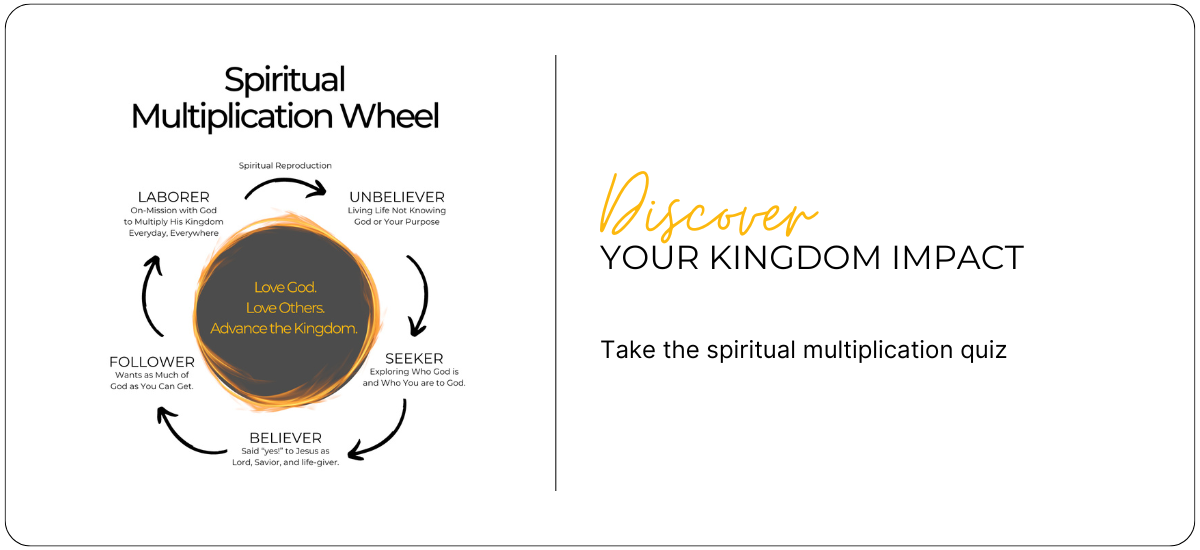
You see when you preach to large crowds, you are limited by the math of addition. People can only be impacted or hear from you. When you invest a lot in just a few and train them to be like you, you change that from addition to multiplication. Instead of there being only one laborer trying to reap the harvest, now there are 13, and then there are 85, and soon 120. Then the number just keeps growing. Multiplication is the key to meeting the great harvest needs of the world around us.
In fact, if you train just one person per year to follow Jesus and share Him with others, and that newly trained person does the same, and the new person they train does the same, and so on, we will be able to reach the whole world in just 34 years or 34 spiritual generations. That’s the power of multiplication. It allows us to make disciples of all nations.
That’s why in Luke 10, Jesus turns to the disciples and says, “The harvest is plentiful, but the workers are few. Ask the Lord of the harvest, therefore, to send out workers into His harvest field. Go! I am sending you…”
That same sending shows up again in Jesus’ final words on a mountain in Galilee—the Great Commission of Matthew 28.
What Does “The Laborers Are Few” Mean for You?
It wasn’t the harvest that was in short supply—it was the harvesters. And that problem still exists today. In every direction, geography, and station of life, people are wanting more, needing more, looking for more. And Jesus continues to ask, “Where are the laborers?”
Notice what Jesus didn’t pray for. He didn’t ask for more pastors, missionaries, writers, singers, or podcasters—as needed and valuable as each of those are. He prayed for laborers. A laborer is a worker who rolls up his or her sleeves and gets things done. No specialized skills are required, just a willing heart with active hands and feet. Everyday people, willing to actively love God and people every day, everywhere.
That’s you. Jesus is looking for willing, roll-up-your-sleeves people to get active in their everyday places of Kingdom harvest. If you genuinely love Jesus and people, you have what it takes. Will you raise your hand? Will you commit yourself to a life of daily laboring for God’s Kingdom? The harvest is plentiful. The laborers are still far too few. It’s time to actively engage in contributing to the answer of Jesus’ more laborers prayer. Not sure where to start? Here are three simple ways to participate in God’s mission — pray, go, and give.
Understanding the scale of the harvest is one thing — but what actually keeps people from stepping up as laborers? Here are four honest reasons the laborers are few, and how to overcome them →
Go Deeper in God’s Mission
Want to keep exploring what it means to live on mission? Here’s where to go next:
- What Does It Mean to Be a Missionary? — the everyday missionary life, for every believer
- God’s Heart for the Nations — why the unreached world is every Christian’s concern
- 5 Signs You Are Called to Be a Missionary — wondering if God is specifically calling you?
- Reach the Unreached: How Every Christian Can Help as a Goer or Sender — the two roles, and the third one to throw out
- How to Become a Missionary — the practical first steps once you sense the call
- From Comfort to Calling: Leaving Home to Share Jesus in Liberia — what a real mission trip costs, and why it’s worth it
- Equipping Your Church for Missions — for church leaders mobilizing their congregation
- Mobilizing Disciples of All Nations — why multiplication is the only answer to the harvest need
- 3 Ways to Participate in God’s Mission — the simplest on-ramp: how to pray, go, and give right now
- What Are Unreached People Groups? — who they are, the numbers, and why every Christian should care
- Has the Gospel Been Preached to All Nations? — what Scripture says about finishing the task
- Matthew 28 and the Great Commission Explained — a phrase-by-phrase walk through Jesus’ marching orders
- Why the Great Commission Matters: Eight Ways to Help Finish It — practical actions for participating in world evangelization
- How to Pray for Missionaries and the Unreached World — five specific ways to pray, drawn from Paul