
What does it mean to be a laborer for Jesus—and could you already be one without knowing it? Laborership is a word we use at Forge for a calling that belongs to every Christian: the everyday, everywhere mission of loving God and loving people right where you are. If you’ve heard this word at a Forge event or in a conversation and wondered what it really means, this is your starting point.
What Laborership Actually Means
Jesus said it plainly in Matthew 9:37–38 (ESV): ”The harvest is plentiful, but the laborers are few. Therefore pray earnestly to the Lord of the harvest to send out laborers into His harvest.”
Notice what He didn’t say. He didn’t pray for more pastors, missionaries, platform speakers, or published authors—as valuable and needed as every one of those callings is. He prayed for laborers.
A laborer is not a title or a position. It’s not something you become after enough training or experience. A laborer is simply someone who rolls up their sleeves and gets to work—right where they are, with what they have, for whoever is in front of them.
A Kingdom Laborer is an ordinary person who actively loves God and loves people every day, everywhere. That’s the whole definition. Ordinary person. Active love. Every day. Everywhere.
That means Laborership isn’t reserved for the bold extrovert. It belongs to the quiet encourager, the faithful giver, the parent discipling their kids at the dinner table, the coworker who prays for the person in the next cubicle, and the neighbor who notices.
(Not sure if you’re a Kingdom Laborer yet? Here are the four characteristics that define one—and how to grow in each of them.)
Why “Laborer” and Not “Leader”?
You may have grown up hearing that every Christian is called to be a leader. It’s a well-intentioned message, but it’s not quite the one Jesus gave us.
Leadership is one spiritual gift among many others found in Scripture. Not everyone has it, and Jesus never asked everyone to pursue it. What He did ask—of every single follower, without exception—was to labor. The difference between leadership and Laborership is worth understanding: one includes everyone and the other doesn’t.
The word “laborer” doesn’t rule anyone out. The quiet person qualifies. The artistic person qualifies. The person who will never stand on a stage or lead a team qualifies. Every Christian, in every season, in every station of life, is called to Laborership.
That’s the beauty of it.
Laborership Happens in Ordinary Moments
We are being invited into ordinary moments, every day, everywhere.
The harvest isn’t only on the mission field or at the evangelism event. It’s in the parking lot, the break room, the checkout line, or the bleachers at your kid’s game. The Kingdom gets built in ordinary moments — through ordinary people who are paying attention.
When people ask, ‘What is Laborership?‘ I tell them it starts with this: paying attention, staying close to Jesus, and refusing to talk yourself out of a moment.
Forge founder Dwight Robertson tells a story about a roofer named James who came to fix his storm-damaged roof. James finished faster than expected and charged less than his original quote. As Dwight wrote the check, James spoke openly: “My desire is to serve God every day by serving my customers with kindness and respect. I treat every roofing job as a daily assignment from God.”
He shared that he regularly prays for his customers by name, asking God for opportunities to minister to them. One of those opportunities came while working on a roof in inner-city Denver when a gunshot sounded from inside the house. He found an older man dying on the floor. With no time and no platform, James knelt beside him and, using yes-or-no eye movements, led the man to Christ. He died moments later.
When Dwight told James that God had uniquely positioned him to reach people few pastors could reach, James went quiet. “I’ve believed that for thirteen years,” he said. “But no one has ever treated my ministry as if it’s important.”
That’s Laborership. Being faithful to love God and love others no matter if no one or everyone is watching.
Then there’s Grace—an elderly widow who lived in a farmhouse in rural Indiana. One leg shorter than the other, gray hair in a bun. After her husband passed away, she found herself with fewer responsibilities and one urgent prayer: Lord, if you’ll show me what you want me to do, I’ll do it.
One day she read an open letter in a prison ministry magazine from an inmate named Bobby who had just given his life to Christ and was asking for a “godly grandmother” to disciple him. Grace wrote the editor and asked to be connected.
She started helping Bobby through a Bible study correspondence course. Bobby led his cellmate to Christ. That cellmate led others. Years later, Grace had a world map on her wall covered in dots—each one a person she was discipling or had discipled. Last she counted, there were more than ten thousand.
“I didn’t know how God could use an old woman like me,” she once told Dwight.
That’s Laborership too.
What is Laborership in Practice?
You don’t need a credential to begin. You don’t need to feel ready. You just need a willing heart and a next step.
Forge has a simple framework for what Laborership looks like in practice:
See. Stop. Spend Time With. Share.
See. Ask God to show you the people around you the way He sees them. Most of us walk past dozens of people every day without really noticing them. Laborership starts with a simple prayer: Lord, let me see who You see. Be creative and look around. People are waiting for hope: they’re sitting next to you on the bus, working beside you, living three houses down. The harvest is plentiful. Jesus wasn’t exaggerating. The only question is whether there are laborers willing to notice.
Stop. Noticing isn’t enough. At some point you have to interrupt your own agenda and respond to what God puts in front of you. That might mean continuing a conversation you were about to walk away from or staying a few extra minutes. It might mean praying and asking God what to do in a situation. The step of stopping is where most Kingdom moments are either seized or missed.
Spend Time With. Ministry isn’t built in a moment; it’s built through consistency, trust, and shared routines. Advancing God’s Kingdom in everyday life often looks less like a dramatic event and more like showing up again and again for the same people. Invest in the person in front of you. Ask questions, listen, and let them know they matter.
Share. Out of that time and trust, share what Jesus has done in your life. You don’t have to have all the answers or preach a sermon. You just have to be willing to say: This is what He’s done for me—and He can do the same for you. God will show you what to do next.
(Want to advance God’s Kingdom in everyday life? It starts closer than you think.)
The Laborers Are Still Few
Jesus’ prayer in Matthew 9 hasn’t been fully answered yet. The harvest is still plentiful. The laborers are still too few.
But here’s the thing: you’re reading this. Which means God may be answering that prayer, at least in part, through you.
Be creative. Look around. People are waiting for hope.
The harvest is plentiful. Let’s go.
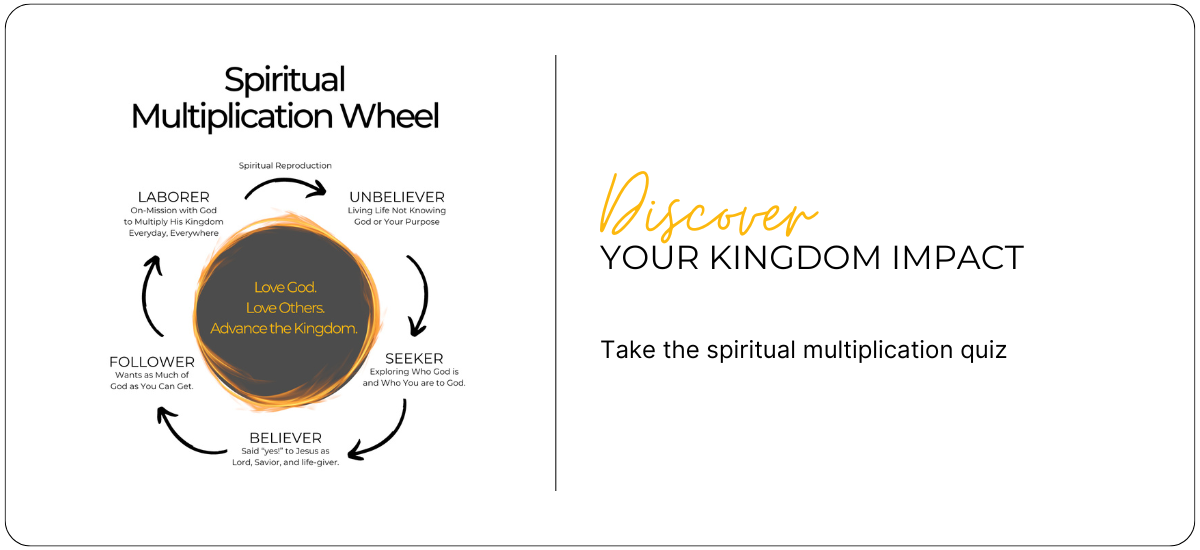
Where are you on the journey? Take the Spiritual Multiplication Quiz and find out your next step.